
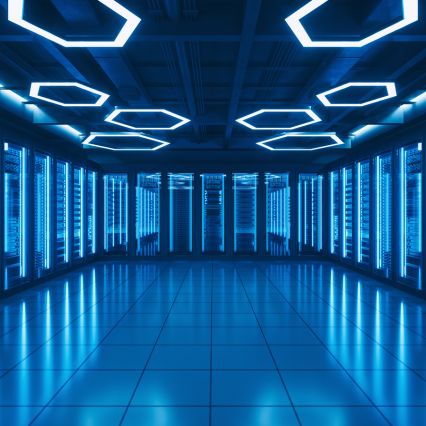
Data centers power nearly every part of modern life. From streaming platforms and cloud computing to AI tools and online banking, they form the backbone of the digital economy. But behind every search query, AI prompt, and video stream lies a growing environmental challenge that often goes unnoticed: water consumption.
As demand for artificial intelligence and cloud infrastructure accelerates across the United States, the amount of water required to keep data centers operational is rising rapidly. While energy use has received widespread attention, water is emerging as one of the industry’s most critical, and controversial, sustainability issues.
Why data centers use so much water
At their core, data centers are massive networks of servers that generate enormous amounts of heat. Without effective cooling, servers can overheat, leading to performance issues, hardware damage, and outages.
To manage this heat, many facilities rely on water-based cooling systems because they are more efficient and cost-effective than traditional air cooling at large scale. Most commonly, data centers use evaporative cooling towers, where water absorbs heat before evaporating into the atmosphere.
The process works well operationally, but it comes at a cost: substantial water consumption.
A mid-sized data center can use approximately 300,000 gallons of water per day, while hyperscale facilities operated by major tech companies can consume between 1 million and 5 million gallons daily under peak conditions.
To put that into perspective, the largest facilities can consume as much water as a town of 10,000 to 50,000 residents.
The scale of America’s data center expansion
The United States currently leads the world in data center capacity. As of 2026, the country hosts more than 4,000 operational data centers – nearly 40% of the global total.
Much of this infrastructure is concentrated in a handful of states:
- Virginia remains the largest data center hub in the world
- Texas continues to see explosive hyperscale growth
- California, Arizona, and Georgia are expanding rapidly due to AI demand
This concentration is creating mounting pressure on local water systems, especially in drought-prone regions.
According to recent industry and environmental research, roughly two-thirds of new hyperscale data center developments since 2022 have been planned in areas already experiencing high or extreme water stress, including parts of Arizona, Texas, and the Colorado River Basin.
At the same time, AI workloads are dramatically increasing cooling requirements. Some analysts estimate U.S. data centers consumed between 17 and 20 billion gallons of water annually in 2024 and 2025, with projections suggesting that figure could rise sharply by the end of the decade.
Why water scarcity is becoming a major risk
The rapid expansion of digital infrastructure is colliding with a growing reality: many of the regions attracting new data center investment are already struggling with water shortages.
States such as Arizona, California, and Texas continue to face recurring drought conditions, declining reservoir levels, and increasing competition for freshwater resources. In some areas, local communities are beginning to question whether large-scale data center development is sustainable long term.
The Colorado River Basin has become a particularly important flashpoint. Water supplies in the region have been under pressure for years, and additional industrial demand from hyperscale campuses is intensifying concerns about long-term resource availability.
Researchers at UC Riverside and Caltech recently warned that U.S. communities may need billions of dollars in additional water infrastructure to support projected data center growth through 2030. Their analysis found that future cooling demands could require up to 1.45 billion gallons of additional peak water capacity per day – roughly equivalent to New York City’s daily water supply.
The transparency problem
One of the biggest challenges facing the industry is the lack of standardized water reporting.
While energy metrics such as Power Usage Effectiveness (PUE) are widely tracked and disclosed, water usage data remains inconsistent across operators. Many companies still do not publicly release detailed site-level water consumption figures.
As investor and community scrutiny grows, pressure is mounting for greater transparency. In 2026, shareholders pushed major hyperscale operators including Amazon, Microsoft, and Google to disclose more detailed water and energy usage data tied to specific facilities.
The industry has increasingly adopted the metric Water Usage Effectiveness (WUE), which measures the amount of water used per unit of IT energy consumption. However, reporting standards and benchmarks remain uneven across the sector.
AI is accelerating the problem
Artificial intelligence is significantly increasing the resource demands placed on data centers.
AI workloads require far more computational power than traditional cloud applications, which in turn generates more heat and increases cooling requirements. This is especially true for large-scale AI model training environments packed with high-density GPUs.
Recent research suggests hyperscale AI data centers could dramatically increase water demand over the next several years if cooling technologies do not improve fast enough.
Ironically, AI is also becoming part of the solution.
Companies including Google are now using machine learning systems to optimize cooling performance in real time, helping reduce both energy and water consumption inside their facilities.
How the industry is trying to reduce water use
Despite growing concerns, the data center industry is actively investing in technologies designed to reduce water consumption.
Advanced cooling technologies
Emerging cooling systems such as liquid immersion cooling and direct-to-chip cooling can dramatically improve efficiency while reducing evaporation losses.
Closed-loop cooling systems are also gaining traction because they recycle water internally instead of continuously consuming fresh water supplies. Some next-generation facilities are achieving Water Usage Effectiveness levels below 0.2 liters per kilowatt-hour, significantly below the industry average.
Reclaimed and non-potable water
Many operators are increasingly turning to reclaimed wastewater and non-potable water sources for cooling operations.
Instead of relying on municipal drinking water, some facilities partner with local utilities to use treated wastewater, reducing strain on freshwater systems.
Smarter site selection
Developers are also beginning to prioritize water availability during site selection.
Historically, data center location decisions focused heavily on power availability, fiber connectivity, and tax incentives. Today, water security is becoming just as important. Regions with cooler climates or more abundant water resources may gain a competitive advantage as environmental scrutiny increases.
The future of sustainable data infrastructure
The United States is entering a new era of digital infrastructure expansion driven by AI, cloud computing, and rising demand for data processing. But the industry’s future growth may depend just as much on water availability as it does on electricity supply.
As communities, regulators, and investors place greater scrutiny on environmental impacts, water is rapidly becoming one of the defining sustainability challenges for the data center sector.
The question is no longer whether data centers consume significant amounts of water. The real question is whether the industry can continue scaling fast enough to support the AI economy while managing one of America’s most finite natural resources.
Hiring engineers or looking for your next opportunity?
The U.S. civil engineering market continues to face a major talent shortage, particularly across water infrastructure, utilities, and construction. Demand for experienced engineers remains exceptionally high, while access to proven technical talent is increasingly limited.
The challenge for employers is no longer identifying qualified professionals — it is securing them before competitors do.
At Alexander Associates, we are seeing especially strong demand for engineers with experience across:
- Water and wastewater treatment
- Water resources
- Land development
- Flood risk management/coastal and environmental
- Commercial sales and business development
In today’s market, organizations that move quickly, remain flexible on requirements, and streamline hiring processes are consistently more successful in attracting and retaining top engineering talent.
We partner with companies across the U.S. civil infrastructure sector to deliver access to highly skilled engineering professionals with the technical expertise and project delivery experience needed to support complex infrastructure programs.
Whether you are hiring for critical project delivery roles or planning long-term team growth, our network and market insight help you secure the right talent faster.
Looking to hire?
Request a call with our team to discuss current market conditions, hiring challenges, and access to civil engineering talent aligned with your project and business requirements.
Looking for your next role?
Register your resume with Alexander Associates to access current opportunities across the U.S. civil engineering and water infrastructure market, aligned with your experience, technical background, and long-term career goals.